You have already read the wavelength counts on the product pages. You know that one mask claims four wavelengths, another claims two, another claims seven-plus. What you have not read — is what each of those wavelengths is actually doing once it reaches your skin.
Premium LED face masks rely on four clinically-supported wavelengths: 415nm (blue), 590nm (yellow/amber), 633nm (red), and 830nm (near-infrared) — each penetrating to a different depth and supporting a different aspect of skin appearance. The number 4 is not arbitrary, and as you'll see below, the logic of combining those four into six treatment modes is where the engineering gets genuinely interesting.
What Each LED Wavelength Is Actually Doing to Your Skin
Each wavelength of light penetrates skin to a different depth, which determines which cells and structures it reaches. Premium LED masks use four wavelengths specifically because they address four distinct depths — and therefore four distinct skin-appearance targets.
The physics is straightforward: shorter wavelengths scatter and stop near the surface; longer wavelengths reach further into the tissue before their energy dissipates. At each depth, photons are absorbed by chromophores — light-sensitive molecules — inside specific cell types. In the most-cited mechanism, those photons activate cytochrome c oxidase in the mitochondria, which increases ATP production and supports downstream skin-appearance effects (Avci et al., 2013; Hamblin, 2017).
In the four-wavelength architecture used by premium masks: 415nm blue light stops in the upper epidermis. 590nm yellow/amber reaches the surface dermis junction. 633nm red light penetrates approximately 1–2mm into the dermis where fibroblasts live. 830nm near-infrared reaches roughly 4–5mm — beyond the dermis into deeper tissue (Avci et al., 2013; Ash et al., 2017).
This is also why combining wavelengths into treatment modes matters. Two wavelengths run simultaneously activate two depths at once. Hold that thought — we'll come back to it after walking through each wavelength on its own.

The Four Wavelengths in a Premium LED Mask: At a Glance
| Wavelength (nm) | Color | Penetration Depth | Skin-Appearance Target | Representative Source |
|---|---|---|---|---|
| 415nm | Blue | Upper epidermis (~0.1–0.5mm) | Helps with the appearance of breakouts; supports a balanced complexion | Kleinpenning et al. 2010; Ash et al. 2017 |
| 590nm | Yellow/Amber | Mid-epidermis / surface dermis (~0.5–1mm) | Surface-tone evenness; supports the look of a radiant, calm complexion | Weiss et al. 2005 |
| 633nm | Red | Dermis (~1–2mm) | Supports the appearance of collagen density; helps smooth the look of fine lines | Wunsch & Matuschka 2014; Barolet et al. 2009 |
| 830nm | Near-Infrared | Deep dermis (~4–5mm) | Supports deeper-tissue appearance of firmness and skin resilience | Wunsch & Matuschka 2014; Hamblin 2017 |
415nm Blue Light — The Surface Wavelength
415nm blue light is absorbed almost entirely in the upper epidermis, where it can help with the appearance of breakouts and support a balanced-looking complexion. It is the shortest and highest-energy wavelength in the four-wavelength set used by premium LED masks, anchored at the skin's surface — the layer where excess oil and breakouts are most visible.
What that means in practice: 415nm works at the surface, where breakouts and sebaceous activity show up. It targets the appearance of areas that look congested or uneven and helps support the look of clearer skin. Kleinpenning and colleagues (2010), publishing in Photodermatology, Photoimmunology & Photomedicine, examined the clinical and histological effects of blue light on normal skin in a controlled setting — useful baseline characterization of how 415nm interacts with the upper epidermis. Ash and colleagues (2017), using computational modeling published in Lasers in Medical Science, confirmed that 415nm wavelengths are absorbed at much shallower depths than red or near-infrared light, which is the physical basis for why blue light's effects are surface-bound.
The honest scope: blue light at this wavelength works at the skin's surface. It does not reach the fibroblast-rich layers where collagen is synthesized — that is the role of 633nm and 830nm. If your concern is deep-set lines or firmness, 415nm is not the wavelength doing that work. If your concern is the appearance of breakouts or an uneven, oily-looking complexion, 415nm is the wavelength that operates at that depth.
A standard safety note: as with all LED therapy devices, 415nm blue light should be used with eyes closed or with the protective goggles specified in your device instructions. This is responsible use, not a fear-based warning — 415nm carries the most energetic photons in the visible range used in these devices, and eye protection is built into the operating instructions of every reputable brand.
590nm Yellow Light — The Tone Wavelength
590nm yellow/amber light penetrates to the skin's surface layer and supports the look of an even, radiant tone. Its operating depth sits between blue and red — deeper than 415nm, shallower than 633nm — at the mid-epidermis to upper-dermis junction. At this depth, it influences the appearance of skin tone and surface evenness rather than the deeper fibroblast layers.
Honest context the reader deserves: the peer-reviewed evidence base for 590nm yellow light is still developing relative to the more extensively studied red and near-infrared wavelengths. The most-cited 590nm paper in the dermatology literature is Weiss and colleagues (2005), Dermatologic Surgery 31(9 Pt 2):1199–1205, which reported clinical observations on LED photomodulation including amber wavelengths. The evidence is suggestive and consistent with the surface-tone framing, but the volume of clinical work on 590nm is meaningfully smaller than what exists for 633nm or 830nm.
That honesty is not a weakness in the case for 590nm — it is the case. The wavelength has a defined operating depth and a coherent skin-appearance target (surface tone, the look of a calm complexion), and it is most useful in combination with the deeper wavelengths rather than as a stand-alone solution. Which is why it shows up in combination treatment modes rather than carrying the bulk of single-wavelength sessions in mode-equipped devices.
If you have read marketing copy associating 590nm with named skin conditions, that is a separate territory. Yellow light at this wavelength supports the look of an even tone; it is not a treatment for any vascular or inflammatory disease state, and credible sources in the dermatology literature do not characterize it that way.
633nm Red Light — The Collagen Wavelength
633nm red light penetrates approximately 1–2mm into the dermis — the layer where fibroblasts live and where the skin's collagen and elastin are synthesized (Avci et al., 2013; Ash et al., 2017). It is the wavelength with the deepest, most-cited evidence base in the LED face-mask literature, and it is the wavelength most readers are picturing when they think of "red light therapy" for skin.
The mechanism, in brief: photons at 633nm are absorbed by cytochrome c oxidase inside fibroblast mitochondria, which increases ATP production and supports fibroblast activity and collagen remodeling (Hamblin, 2017). Barolet and colleagues (2009), publishing in the Journal of Investigative Dermatology, used a pulsed 660nm LED source to examine how this wavelength regulates skin collagen metabolism, with clinical correlation in a single-blinded study — supporting the broader picture of how light at this part of the spectrum interacts with the dermal collagen pathway.
According to a controlled clinical trial by Wunsch and Matuschka (2014), published in Photomedicine and Laser Surgery 32(2):93–100, 113 volunteers undergoing red and near-infrared LED treatment showed significant improvements in fine lines, skin roughness, and intradermal collagen density over 30 sessions. This is the most-cited LED-face study in the direct-to-consumer space, and it is the empirical anchor for the standard structure-and-function framing — that 633nm supports the appearance of collagen density and helps smooth the look of fine lines.
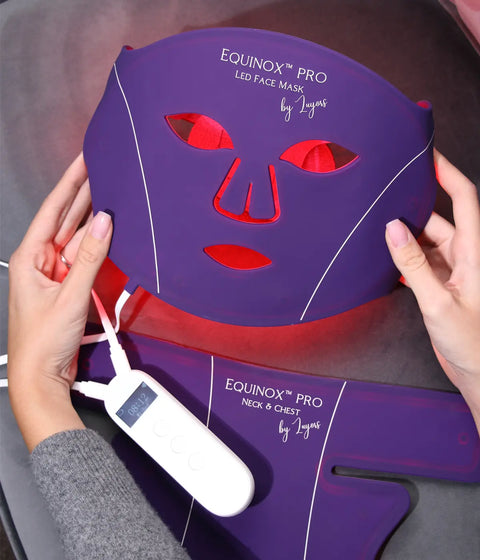
This is the wavelength that has produced the most peer-reviewed face-specific evidence, and it is the architectural anchor of premium four-wavelength masks. In the Luyors Equinox Pro (Health Canada approved), 633nm is the central wavelength of the Red mode and appears in four of the six combination modes — paired with NIR, with Blue, with Yellow, or run alone.
830nm Near-Infrared — The Depth Wavelength
830nm near-infrared light is invisible to the eye but penetrates approximately 4–5mm — reaching beyond the dermis into deeper tissue structures (Avci et al., 2013; Ash et al., 2017). This is the deepest-penetrating wavelength in the four-wavelength set, and the source of the post's most common reader question: how is it different from 633nm red, and does the difference matter?
The short answer: 633nm targets the fibroblast-rich upper dermis where collagen is synthesized; 830nm reaches deeper, where the appearance of firmness originates. 633nm red light penetrates approximately 1–2mm into the skin and supports the appearance of collagen density, while 830nm near-infrared penetrates 4–5mm and supports deeper-tissue firmness (Avci et al., 2013; Wunsch & Matuschka, 2014). Both wavelengths activate the same cytochrome c oxidase pathway described in the 633nm section above; the difference is the depth at which that activation happens, which means the two wavelengths reach different cellular populations (Hamblin, 2017; Hamblin, 2018).
A nuance worth correcting if you have spent any time in biohacker corners of the internet: deeper penetration is not categorically better. It means NIR reaches different structures than red light, not superior ones. The two wavelengths are complementary, and that is precisely why the most-cited clinical study in this space — Wunsch and Matuschka (2014) — examined a combination of red and near-infrared rather than either wavelength alone. The evidence-backed pairing in the LED face-mask literature is red plus NIR together, not one without the other.
For the reader who already owns a single-wavelength device: this is the gap your current device may not be addressing. If you are using a red-only mask, you are working in the upper dermis but not beyond it. If you are using an NIR-only device, you are reaching deep tissue but not the fibroblast layer where collagen synthesis is most concentrated. The reason combination devices exist is that the literature has consistently studied these wavelengths together.
Why Four Wavelengths Get Combined Into Six Treatment Modes
Here is the payoff the four-wavelength architecture has been building toward.
A treatment mode is a pre-set combination of wavelengths operated simultaneously. Because each wavelength penetrates to a different depth and activates different cellular pathways, combining two wavelengths in a single session means activating two depths at once — not "more of the same." This is the structural reason multi-mode devices exist, and it is the answer to the reasonable question of whether modes are "just marketing."
The math, briefly: four wavelengths can produce ten possible pairings (4+3+2+1 across single, double, triple, and quad combinations). Premium mask architectures select a subset that are clinically and functionally coherent — the combinations that map to skin-appearance goals readers actually have. The Luyors Equinox Pro (Health Canada approved) uses six such combinations across its 656 LEDs, allowing the same device to address different skin-appearance goals across different sessions.

The six Equinox Pro treatment modes:
- Red + NIR: Pairs 633nm and 830nm to support the appearance of collagen density and deeper-tissue firmness simultaneously. This is the wavelength pairing studied directly in Wunsch and Matuschka (2014).
- Red + Blue: Pairs 633nm and 415nm to address both the dermis and the skin's surface layer in a single session — supporting the appearance of collagen density alongside helping with the look of breakouts.
- Red + Yellow: Pairs 633nm and 590nm to support the appearance of collagen density alongside surface-tone evenness.
- Yellow + NIR: Pairs 590nm and 830nm to support surface-tone appearance alongside deeper-tissue firmness.
- Red: Focuses 633nm on supporting the appearance of collagen density in the dermis.
- Yellow: Focuses 590nm on supporting the look of an even, radiant surface tone.
Why this matters from the reader's seat: instead of choosing one wavelength per session — or buying separate devices for separate concerns — a mode-equipped mask lets you target multiple depths simultaneously, or focus on a single concern when that is what the day calls for. Six modes is not six different products; it is six different session shapes within one device.
This is also where four-wavelength architecture earns its premium over two- and three-wavelength devices. Two wavelengths gives you essentially one meaningful combination plus two single-wavelength options. Four wavelengths combined into six modes gives you six clinically coherent session shapes — six is not "better" in some absolute sense, but it is a wider range, which is the relevant spec for buyers whose concerns are not contained to a single skin-appearance goal.
How Many Wavelengths Does an LED Mask Actually Need?
There is no universal correct answer. The right wavelength count depends on which skin-appearance concerns you are prioritizing, and a higher number is not automatically better.
A working rubric, based on what each wavelength actually does:
- 1 wavelength : Sufficient if you have a single, specific concern — a 633nm-only device, for example, will support the appearance of collagen density in the dermis and nothing else. Limited overall coverage, but coherent for narrow goals.
- 2 wavelengths : The most evidence-backed pairing in the peer-reviewed literature. Covers the fibroblast-rich dermis and the deeper tissue beneath it. A strong choice if your primary concerns are firmness and the appearance of fine lines.
- 3 wavelengths : Adds an additional depth band. Useful for buyers who want extended depth coverage without venturing into surface-layer wavelengths.
- 4 wavelengths (adding 415nm blue and 590nm yellow alongside red and NIR): Full depth spectrum from upper epidermis to deep dermis. Necessary only if you also want to help with the appearance of breakouts and address surface tone alongside collagen and firmness.
More wavelengths are not inherently better. The right number is the number that addresses your specific skin-appearance concerns, and the right device is the one whose wavelengths and modes match the goals you actually have. Treatment modes amplify the value of wavelengths — four wavelengths combined into six modes gives you six session shapes, not four; that range is the relevant specification when concerns are plural.
Frequently Asked Questions
Q1: What does 415nm blue light do for skin?
415nm blue light is absorbed in the upper epidermis — the skin's surface layer. At this depth, it can help with the appearance of breakouts and support the look of a balanced, clearer complexion. Because it does not penetrate to the dermis, it works at the skin's surface rather than at the deeper collagen layer.
Q2: What is the difference between red light and near-infrared light in an LED mask?
Red light (typically 633nm) penetrates approximately 1–2mm into the dermis and supports the appearance of collagen density. Near-infrared light (typically 830nm) penetrates approximately 4–5mm — reaching deeper tissue structures where the appearance of firmness originates. Both activate cellular pathways, but at different depths, which is why many clinical studies examine them as a combination.
Q3: How many wavelengths does an LED mask need to be worth it?
There is no single correct number — it depends on which skin-appearance concerns you're prioritizing. Two wavelengths (red + near-infrared) cover the most evidence-backed pairing for collagen and firmness appearance. Four wavelengths add surface-layer and tone coverage. More wavelengths extend the device's range; they do not guarantee better results for any individual concern.
Q4: Are treatment modes on an LED mask just marketing?
Treatment modes are pre-set wavelength combinations, not separate hardware features. Because different wavelengths penetrate to different depths, combining two simultaneously activates two skin-layer targets at once. Six modes from four wavelengths means six distinct session options — each targeting a different combination of depth and skin-appearance goal. Whether that range is worth the premium depends on the breadth of concerns you want to address.
Q5: Is blue light therapy safe for the face?
At the intensities used in regulated LED face devices, 415nm blue light is considered safe for facial skin. The primary precaution is eye protection: 415nm wavelengths should be used with eyes closed or with the protective goggles specified in your device instructions. If you take photosensitizing medications or have photosensitivity conditions, consult your dermatologist before use.
Q6: What wavelength is most effective for the appearance of collagen?
633nm red light has the most extensive peer-reviewed evidence for supporting the appearance of collagen density in face-specific applications. A controlled clinical trial by Wunsch and Matuschka (2014) found significant improvements in fine lines, skin roughness, and intradermal collagen density across 113 volunteers. 830nm near-infrared targets the same collagen-support goal at a deeper tissue level.
Q7: Can I use the Equinox Pro if my LED mask has fewer wavelengths?
If you currently use a single- or two-wavelength device, it is not ineffective — it is covering the wavelengths it was built for. The Equinox Pro (Health Canada approved) adds surface-layer and tone coverage through its 415nm and 590nm wavelengths, and its six treatment modes allow you to combine wavelengths per session. Whether the expanded range addresses your specific skin-appearance goals is a personal decision.
Conclusion
You now have the wavelength-by-wavelength architecture: 415nm at the surface, 590nm just below it, 633nm in the dermis, 830nm beyond it — four depths, four skin-appearance targets, and six clinically coherent ways to combine them. The number on a product page is not the spec. The spec is what each of those numbers is doing once it reaches your skin, and whether the combination matches the concerns you actually want to address.
If you are ready to see how the four-wavelength architecture takes shape in a specific device, or to dig into the cellular mechanism that makes any of this work, the next steps are below.
Disclaimer. The information in this article is intended for educational purposes and describes skin-appearance effects in structure/function terms. It does not constitute medical advice. Individual results vary. If you have a skin condition, are pregnant, take photosensitizing medications, or have questions about LED therapy for your specific health situation, consult a board-certified dermatologist or licensed healthcare provider before use. The Equinox Pro is Health Canada approved.